

How Do We Make Negative Sentences in Present Simple?
To make a sentence negative in the Present Simple, we add a special word before the main verb. This word is don’t 或 doesn’t.
These are short forms:
- don’t is short for do not.
- doesn’t is short for does not.
The main verb in the sentence always stays in its base form. This means it does not change, even for he, she, it.
[langcom_cta variant=”blended”]
When Do We Use ‘Don’t’?
我们使用 don’t when the subject of the sentence is:
- I
- You
- We
- They
- Or a plural noun (e.g., my friends, the students).
The structure is: Subject + don’t + base form of the verb.
When Do We Use ‘Doesn’t’?
我们使用 doesn’t when the subject of the sentence is:
- He
- She
- It
- Or a singular noun (e.g., my dad, the dog).
The structure is: Subject + doesn’t + base form of the verb. Remember, the verb does not end in ‘-s’ after doesn’t.
| 主题 | Negative Form | Main Verb |
|---|---|---|
| I | don’t | work |
| You | don’t | work |
| We | don’t | work |
| They | don’t | work |
| He | doesn’t | work |
| She | doesn’t | work |
| It | doesn’t | work |
示例
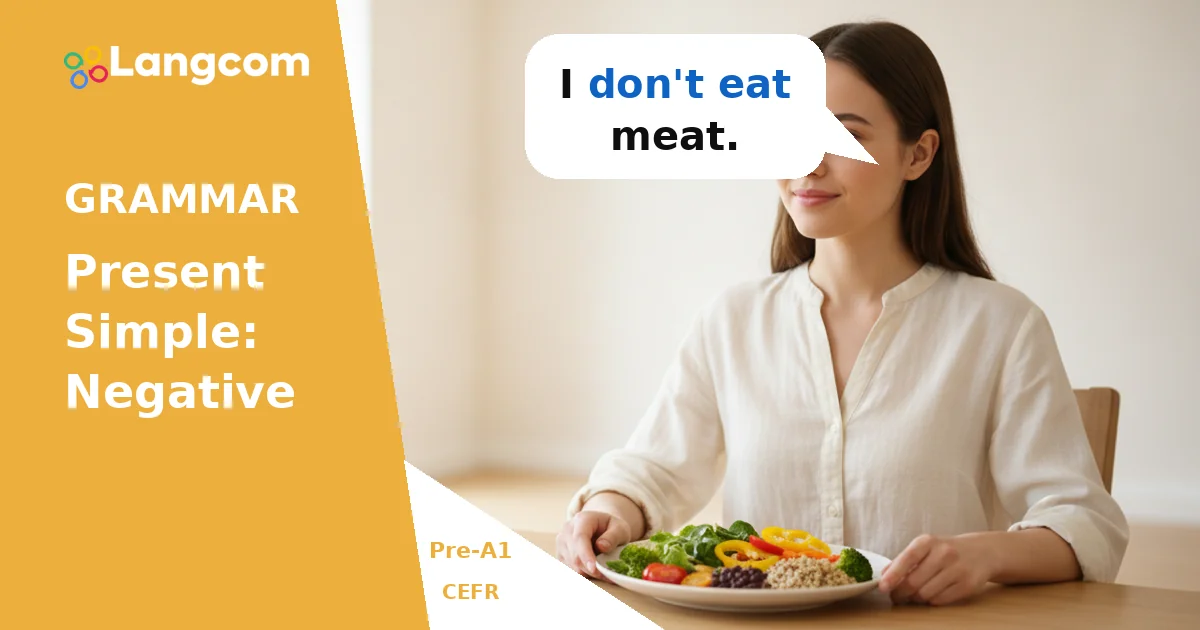
- I don’t eat meat.
- You don’t live in a big city.
- We don’t watch TV in the morning.
- They don’t play football on Tuesdays.
- He doesn’t like pizza.
- She doesn’t work on weekends.
- It doesn’t rain much in summer here.
练习
[langcom_cta variant=”whatsapp”]
西班牙语母语者常犯的错误
Spanish speakers often say I no like coffee. This is incorrect in English. You must use don’t 或 doesn’t. The correct way is I don’t like coffee.
Another common mistake is adding ‘-s’ to the verb after doesn’t. 例如,, She doesn’t likes pizza is wrong. The correct form is She doesn’t like pizza. The verb always stays in its base form after don’t 或 doesn’t.
常见问题
What is the short form of do not and does not?
The short form of do not 是 don’t. The short form of does not 是 doesn’t.
Does the verb change after don’t or doesn’t?
No, the main verb always stays in its base form after don’t 或 doesn’t. 例如,, He doesn’t eat, not He doesn’t eats.
Can I use don’t or doesn’t for all verbs?
You use don’t 或 doesn’t for most action verbs in the Present Simple. For the verb to be (am, is, are), you make it negative differently (e.g., I am not, He is not).



0 条评论