

What are Quantifiers?
Quantifiers are words that tell us about the amount or quantity of something. They answer the question “How much?” or “How many?”.
In English, choosing the correct quantifier depends on the noun it describes. Nouns can be countable or uncountable.
🎓 Learn English with the Blended method
Grupos reducidos · Tutor de IA disponible las 24 horas del día, los 7 días de la semana · Preparación para los exámenes de Cambridge
Planes de $39 $79 al mes
Countable Nouns vs. Uncountable Nouns
- Countable Nouns: These are things you can count. They have singular and plural forms.
Examples: one apple, two apples; one car, three cars; one student, many students. - Uncountable Nouns: These are things you cannot count individually. They usually do not have a plural form.
Examples: water, sugar, information, money, advice.
When to Use Much?
Utilizamos much with uncountable nouns.
- It is most common in questions and negative sentences.
- Example question: How much money do you have?
- Example negative sentence: I don't have much time.
When to Use Many?
Utilizamos many with countable nouns.
- It is most common in questions and negative sentences.
- Example question: How many books do you read?
- Example negative sentence: There aren't many students in the class.
When to Use A Lot (of)?
A lot of is very useful because you can use it with both countable and uncountable nouns.
- It is common in affirmative (positive) sentences.
- Example with countable noun: She has a lot of friends.
- Example with uncountable noun: He drinks a lot of coffee.
- You can also use a lot of in questions and negative sentences, but much y many are often preferred in formal contexts.
Summary: Countable vs. Uncountable Nouns
Remember this simple rule:
- Uso many for things you can count (e.g., apples).
- Uso much for things you cannot count (e.g., water).
- Uso a lot of for both!
| Quantifier | Use with Countable Nouns | Use with Uncountable Nouns |
|---|---|---|
| Much | No (e.g., not much apples) | Yes (e.g., much water) |
| Many | Yes (e.g., many apples) | No (e.g., not many water) |
| A lot (of) | Yes (e.g., a lot of apples) | Yes (e.g., a lot of water) |
Ejemplos
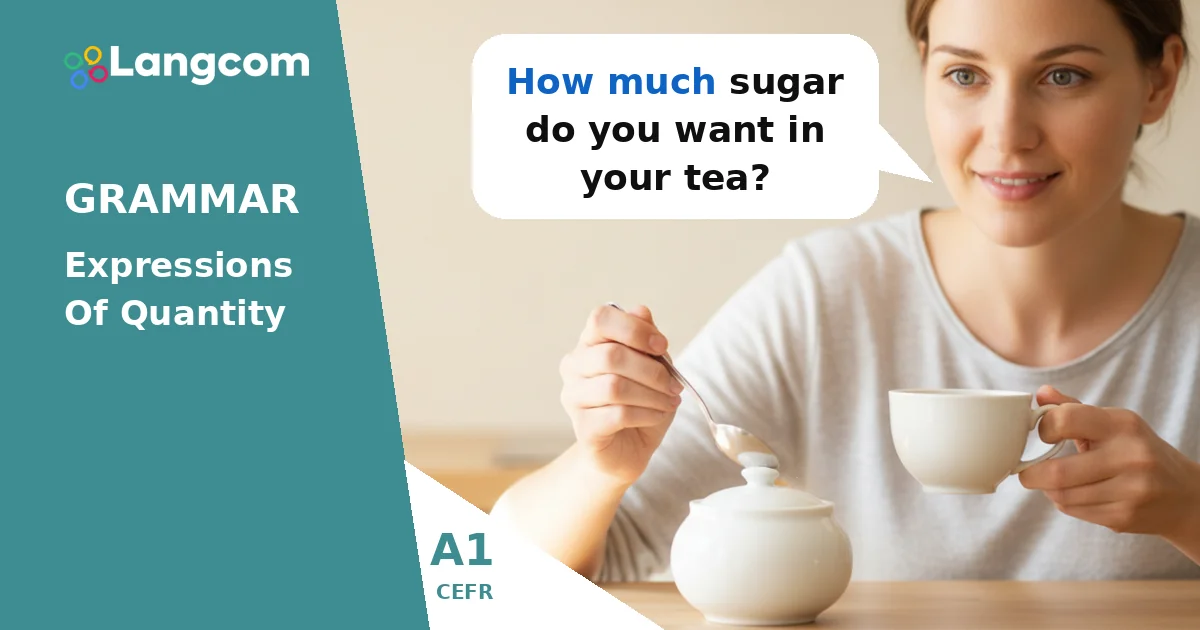
- How much sugar do you want in your tea?
- I don't have much patience.
- Are there many people at the party?
- She doesn't own many clothes.
- We have a lot of food for dinner.
- They bought a lot of new furniture.
Práctica
💬 ¿Necesitas asesoramiento personalizado?
Como centro autorizado de preparación para los exámenes de Cambridge, podemos orientarte para que elijas el curso y la certificación más adecuados. Habla hoy mismo con nuestros asesores.
Chatea con un asesor por WhatsAppErrores habituales de los hispanohablantes
Los hispanohablantes a veces confunden much y many because 'mucho/a' can be used for both countable and uncountable nouns in Spanish.
- Mistake: I have much books. (Incorrect)
- Correction: I have many books. (Correct, because 'books' are countable)
- Mistake: How many water do you drink? (Incorrect)
- Correction: How much water do you drink? (Correct, because 'water' is uncountable)
- Recuerda: For positive sentences, a lot of is a safe choice for both: I have a lot of books. y I drink a lot of water.
Preguntas más frecuentes
What is the main difference between 'much' and 'many'?
The main difference is that we use much with uncountable nouns (like milk) and many with countable nouns (like bottles).
Can I always use 'a lot of' instead of 'much' or 'many'?
Sí, a lot of can be used with both countable and uncountable nouns. It is very common in positive sentences. In questions and negative sentences, much y many are also common.
Are 'much' and 'many' usually used in positive sentences?
No, much y many are more common in questions and negative sentences. For positive sentences, a lot of is usually preferred. For example, say I have a lot of friends, no I have many friends (unless you want to emphasize a large number).
How do I know if a noun is countable or uncountable?
If you can put a number before a noun (like one apple, two apples), it's countable. If you cannot count it individually and it doesn't have a plural form (like information, rice), it's uncountable.




0 Comentarios