

What Are Comparative Adverbs?
Comparative adverbs are words that modify verbs, other adverbs, or adjectives. They help us compare how two actions are performed.
Think of them as telling you if someone does something faster, more carefully, ، أو less often than someone else.
- They answer the question “How?”
- They show a difference in the way an action is done.
- They are different from comparative adjectives, which describe nouns.
✍️ لست متأكدًا من مستواك؟
خُذ اختبار تحديد المستوى المجاني الخاص بنا واحصل على تعليقات مخصصة من ممتحنين معتمدين من كامبريدج.
قم بإجراء اختبار تحديد المستوى المجانيHow Do We Form Comparative Adverbs?
The way we form comparative adverbs depends on the adverb's length and ending.
- Short Adverbs (one syllable): Add -er to the end.
- hard → harder
- fast → faster
- late → later
- Adverbs ending in -ly or longer adverbs (two or more syllables): الاستخدام more أو less before the adverb.
- carefully → more carefully / less carefully
- quickly → more quickly / less quickly
- frequently → more frequently / less frequently
- Irregular Adverbs: Some adverbs have special comparative forms that you need to learn.
- well → better
- badly → worse
- far → farther / further
- little (meaning 'small amount') → less
- much → more
When Do We Use 'Than' with Comparative Adverbs?
When you compare two specific actions or things, you often use the word than after the comparative adverb.
It helps to clearly show what is being compared.
- She drives more carefully than her brother.
- He finished the race faster than anyone else.
You can omit than if the comparison is clear from the context.
- He used to work slowly, but now he works faster. (The comparison is implied with "used to" and "now")
How Can You Use Comparative Adverbs Effectively?
Comparative adverbs are very useful for adding detail and precision to your descriptions of actions.
- Describing improvements or changes: She speaks English much more fluently now.
- Comparing performance: Our team played better today than last week.
- Expressing preferences: I prefer to study more quietly.
- Giving instructions: Please write more clearly next time.
| Adverb | Comparative Form | جملة مثال |
|---|---|---|
| fast | faster | He runs faster. |
| hard | harder | She works harder. |
| carefully | more carefully | Please listen more carefully. |
| quickly | less quickly | They finished less quickly than us. |
| well | better | I feel better today. |
| badly | worse | He performed worse in the second half. |
أمثلة
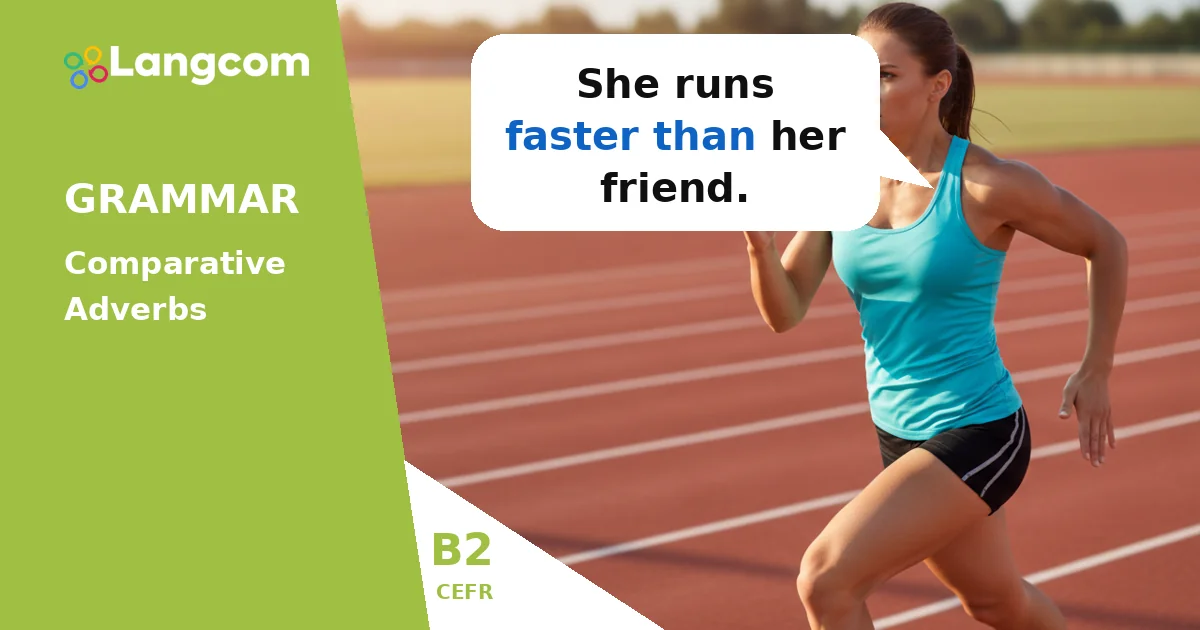
- She runs faster than her friend.
- He speaks English more fluently now.
- They arrived earlier than expected.
- Please drive more slowly in this area.
- The new software works much more efficiently.
- I slept less soundly last night.
- He writes more neatly than his sister.
- She reacted worse to the news than I did.
- Can you explain it more simply?
- We need to work harder to meet the deadline.
التدريب
هل أنت مستعد للحصول على شهادتك؟
يُعد برنامج Langcom الطلاب لامتحانات كامبريدج وIELTS وTOEFL وDELE وSIELE وMichigan.
ابدأ مع Langcomالأخطاء الشائعة لدى المتحدثين باللغة الإسبانية
Spanish speakers often make a few common mistakes when using comparative adverbs in English.
- Confusing adverbs with adjectives: Remember, adverbs modify verbs, adjectives, or other adverbs. Adjectives modify nouns.
- خطأ: He drives more quick. (Quick is an adjective)
- الصحيح: He drives more quickly. (Quickly is an adverb)
- Incorrect formation of short adverbs: Do not use more with short adverbs.
- خطأ: She runs more fast.
- الصحيح: She runs faster.
- Omitting than: When making a direct comparison between two things, remember to include than.
- خطأ: He speaks better me.
- الصحيح: He speaks better than me.
الأسئلة الشائعة
What is the main difference between comparative adverbs and comparative adjectives?
Comparative adverbs describe how an action is performed, modifying verbs, other adverbs, or adjectives. For example, She sings more beautifully. Comparative adjectives describe nouns, showing a difference in quality between two things. For example, She is more beautiful.
Can I use words like 'much' or 'a lot' to make comparative adverbs stronger?
Yes, you can! To emphasize a greater difference, you can use words like much, a lot, far, ، أو significantly before the comparative adverb. For example, He drives much faster now. أو She works a lot more carefully.
Are there any adverbs that do not have a comparative form?
Yes, some adverbs do not have comparative forms because their meaning is absolute or already implies a comparison. Examples include adverbs of time like always, never, daily, and adverbs of degree like completely, perfectly. You wouldn't say more always.
How are comparative adverbs tested in the B2 First (FCE) exam?
Comparative adverbs are often tested in the B2 First Use of English paper, particularly in Part 2 (Open Cloze) where you might need to supply the correct comparative form of an adverb, or Part 3 (Word Formation) where you might need to form an adverb from an adjective and then put it into its comparative form. They can also appear in Part 4 (Key Word Transformations) where you rewrite sentences using comparative structures.




0 تعليق