

What Are Attitude Adjectives?
Attitude adjectives are words we use to describe a person’s general way of thinking or feeling about things. They show their perspective or outlook.
- They tell us if someone expects good or bad results.
- They describe how someone views other people’s motives.
- They explain if someone accepts things as they are or questions them.
These adjectives are different from personality adjectives, which describe fixed traits like friendly 或 shy. Attitude adjectives often describe a person’s reaction to a specific situation or their general approach to life.
Key B2 Adjectives for Describing Attitudes
Let’s explore some important adjectives you can use to describe different attitudes:
- Optimistic: Someone who is optimistic always expects good things to happen. They focus on the positive side of any situation.
- Pessimistic: This is the opposite of optimistic. A pessimistic person expects bad things to happen. They often focus on the negative aspects.
- Realistic: A realistic person sees things as they truly are, without expecting them to be better or worse than they are. They consider facts and possibilities.
- Cynical: Someone who is cynical believes that people are generally selfish and dishonest. They often doubt the sincerity of others’ motives.
- Skeptical: If you are skeptical, you doubt that something is true or valid. You need proof or evidence before you believe a claim or idea.
Why Are These Adjectives Important for B2 Learners?
At the B2 level, you need to express more complex ideas and understand subtle differences in meaning. These adjectives help you:
- Describe opinions: You can explain not just *what* someone thinks, but *how* they think. For example, She has an optimistic view of the future.
- Understand perspectives: When reading or listening, these words help you grasp the speaker’s or writer’s underlying attitude.
- Improve communication: Using precise adjectives makes your English sound more natural and sophisticated. You can avoid simpler, less accurate descriptions.
| Adjective | Meaning | Example Sentence |
|---|---|---|
| Optimistic | Expects good things to happen; positive outlook. | She is optimistic about her exam results. |
| Pessimistic | Expects bad things to happen; negative outlook. | He’s pessimistic about the future of the economy. |
| Realistic | Sees things as they truly are; practical. | We need a realistic plan for the project. |
| Cynical | Believes people are selfish and dishonest. | Many people are cynical about politicians’ promises. |
| Skeptical | Doubts claims or beliefs; needs proof. | I’m skeptical of any easy solutions to complex problems. |
示例
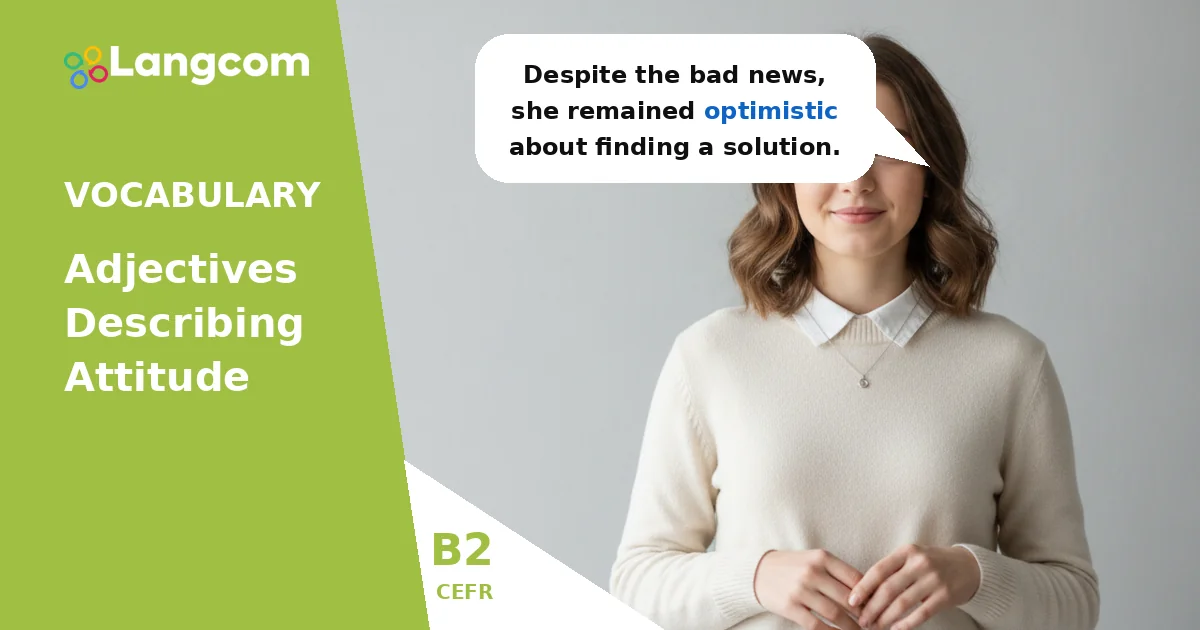
- Despite the bad news, she remained optimistic about finding a solution.
- He’s always so pessimistic; he thinks the project will fail before it even starts.
- It’s important to be realistic about your chances of winning the lottery.
- After many broken promises, he became cynical about politicians.
- I’m skeptical of claims that this new diet can make you lose 10 kilos in a week.
- Her optimistic attitude helped the team stay positive during difficult times.
- Don’t be so pessimistic; let’s try to find a way to make it work.
- A realistic approach to budgeting will help you save money.
- Many cynical people believe that all companies care about is profit.
- The scientist was skeptical of the new theory until he saw the experimental results.
练习
西班牙语母语者常犯的错误
Spanish speakers sometimes make mistakes with these adjectives, often confusing them with adverbs or using the wrong verb.
- Using an adverb instead of an adjective: Remember, adjectives describe nouns (people, things), while adverbs describe verbs or other adjectives.
错误: I feel optimistically about the exam.
正确: I feel optimistic about the exam. (Here, optimistic describes ‘I’) - Using the wrong verb: Attitudes are often expressed with the verb to be 或 to feel.
错误: She has pessimistic.
正确: She is pessimistic. 或 She feels pessimistic. - Confusing similar words: For example, cynical implies a belief in selfishness, while skeptical means doubting a specific claim or truth.
错误: He is cynical about ghosts. (Unless he believes ghosts are selfish!)
正确: He is skeptical about ghosts.
常见问题
What is the difference between ‘optimistic’ and ‘positive’?
Optimistic specifically means expecting good things to happen in the future. Positive is a broader term, meaning good or favorable. You can have a positive attitude, which includes being optimistic, but also being cheerful, constructive, and helpful. So, optimistic is a type of positive attitude about the future.
Can these adjectives describe things, not just people?
Yes, they can! While they primarily describe people’s attitudes, they can also describe things that reflect an attitude or perspective. For example, you can talk about an optimistic outlook, a pessimistic report, 或 a realistic goal. In these cases, the adjective describes the nature or quality of the thing, reflecting a certain attitude.
How can I remember these new words?
The best way is to use them in context! Try to describe people you know or situations you encounter using these adjectives. Think of opposites, like optimistic 和 pessimistic. You can also create flashcards with example sentences. Reading English news or articles and identifying these words in use will also help them stick in your memory.
Are these adjectives important for B2 English exams?
Absolutely! At the B2 level, exams often require you to express opinions, discuss social issues, and describe people or situations in detail. Using adjectives like optimistic, pessimistic, cynical, , 和 skeptical allows you to show a sophisticated vocabulary and express nuanced ideas, which is highly valued in tasks like essay writing or speaking discussions.



0 条评论