

Why are descriptive adjectives important for travel?
When you talk about your travels, you want to share the excitement and beauty of the places you visited. Simple words like ‘good’ or ‘nice’ do not always capture the true feeling of an experience.
Using stronger, more specific adjectives helps you:
- Paint a clearer picture: Your listener can imagine the place better.
- Express your emotions: Show if you were amazed, delighted, or impressed.
- Sound more fluent: Demonstrate a richer vocabulary, which is important at B2 level.
- Make your stories more engaging: Keep your audience interested in what you are saying.
✍️ Non sai a quale livello ti trovi?
Fai il nostro test di livello gratuito e ricevi un feedback personalizzato da esaminatori certificati Cambridge.
Fai il nostro test di livello GRATUITOAdjectives for truly amazing and beautiful places
These adjectives describe places that are incredibly beautiful, impressive, or surprising.
- Breathtaking: So beautiful, dramatic, or impressive that it takes your breath away. It means you are filled with awe.
- Stunning: Extremely impressive or attractive. It suggests something is strikingly beautiful.
- Astonishing: Extremely surprising or impressive. It implies something is so wonderful it causes great surprise.
- Impressive: Evoking admiration through size, quality, or skill. It means something makes you feel respect.
- Remarkable: Worthy of attention; unusual or striking. It means something is special and stands out.
Adjectives for unique and memorable experiences
These words help you describe experiences that are special, different, or unforgettable.
- Unique: Being the only one of its kind; unlike anything else. If something is unique, there is nothing similar to it.
- Exotic: Originating in or characteristic of a distant foreign country; unusual and exciting. It often refers to places or cultures that feel very different from your own.
- Memorable: Worth remembering or easily remembered, especially because of being special or unusual. A memorable trip is one you will not forget.
Adjectives for excellent quality and strong visual impact
These adjectives describe things that are of very high quality or have a powerful visual effect.
- Superb: Excellent; of very high quality. You can use this for food, service, or accommodation.
- Dramatic: Sudden and striking, or full of action and excitement. Often used for landscapes with strong visual contrasts, like mountains or coastlines.
| Aggettivo | Meaning | Example |
|---|---|---|
| Breathtaking | Extremely impressive or beautiful. | The mountain scenery was breathtaking. |
| Stunning | Extremely attractive or impressive. | We saw a stunning sunset over the ocean. |
| Astonishing | Extremely surprising or impressive. | The ancient city’s architecture was astonishing. |
| Impressive | Evoking admiration; making a strong positive impact. | The sheer size of the waterfall was impressive. |
| Remarkable | Unusual or special and therefore surprising and worth mentioning. | Her ability to speak five languages was remarkable. |
| Unique | Being the only one of its kind; very special. | The island offered a unique cultural experience. |
| Exotic | From a distant foreign country; unusual and exciting. | We tried many exotic fruits on our trip. |
| Memorable | Worth remembering or easily remembered because it is special. | It was the most memorable holiday of my life. |
| Superb | Excellent; of very high quality. | The food at the restaurant was superb. |
| Dramatic | Striking in appearance or effect; full of action. | The coastline had dramatic cliffs and caves. |
Esempi
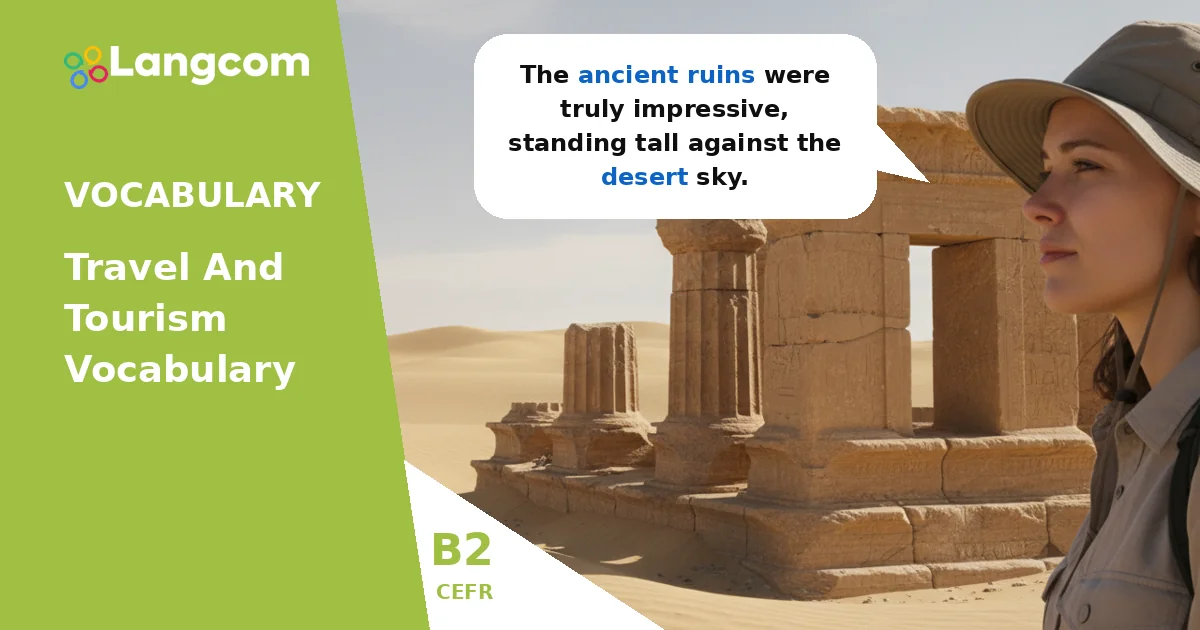
- The ancient ruins were truly impressive, standing tall against the desert sky.
- We stayed in a superb hotel with breathtaking views of the ocean.
- Visiting the remote village was a unique and memorable experience that I’ll cherish forever.
- The exotic flavors of the local cuisine were astonishing; I’d never tasted anything like it before!
- The dramatic cliffs along the coastline made for stunning photographs at sunset.
Esercitazione
Ready to earn your certificate?
Langcom prepares students for Cambridge, IELTS, TOEFL, DELE, SIELE and Michigan exams.
Get started with LangcomErrori comuni per chi parla spagnolo
Overusing ‘very’ with simple adjectives
Many learners tend to say very good oppure very beautiful. At B2 level, you should replace these with stronger, more precise adjectives. Instead of The scenery was very beautiful, say The scenery was stunning oppure breathtaking.
Confusing adjectives with similar meanings
Be careful with words that seem similar but have different nuances. For example, impressive describes something that causes admiration, while astonishing implies great surprise. Choose the word that best fits the specific emotion or quality you want to convey.
Using adjectives as adverbs
Remember that adjectives describe nouns. Do not use them to describe verbs. For example, say The food was superb (adjective describing ‘food’), not The food was superbly (adverb). If you need an adverb, you would typically add ‘-ly’, but for these strong adjectives, it’s often better to use the adjective with a linking verb (e.g., ‘was’, ‘seemed’).
Domande frequenti
What is a descriptive adjective?
A descriptive adjective is a word that describes a noun or pronoun, giving more information about its qualities, characteristics, or state. For example, in a breathtaking view, breathtaking is the descriptive adjective.
How can I remember new travel vocabulary?
To remember new vocabulary like these adjectives, try to use them actively. Write sentences about your past trips, describe photos, or talk about places you want to visit. Create flashcards, use them in conversations, or even write a short travel blog entry. Repetition and real-world application are key.
Are these adjectives suitable for formal or informal English?
These adjectives are generally suitable for both formal and informal English when describing travel. They are strong and expressive, making them appropriate for a wide range of contexts, from casual conversations with friends to more formal presentations or written reports about tourism.
How can these adjectives help me in a B2 English exam?
In a B2 English exam, especially in speaking or writing tasks, using a range of advanced descriptive adjectives like stunning, unique, oppure memorable will help you achieve a higher score. They demonstrate a rich vocabulary and the ability to express nuanced ideas, which is crucial for describing experiences, places, or pictures effectively.



0 Commenti