
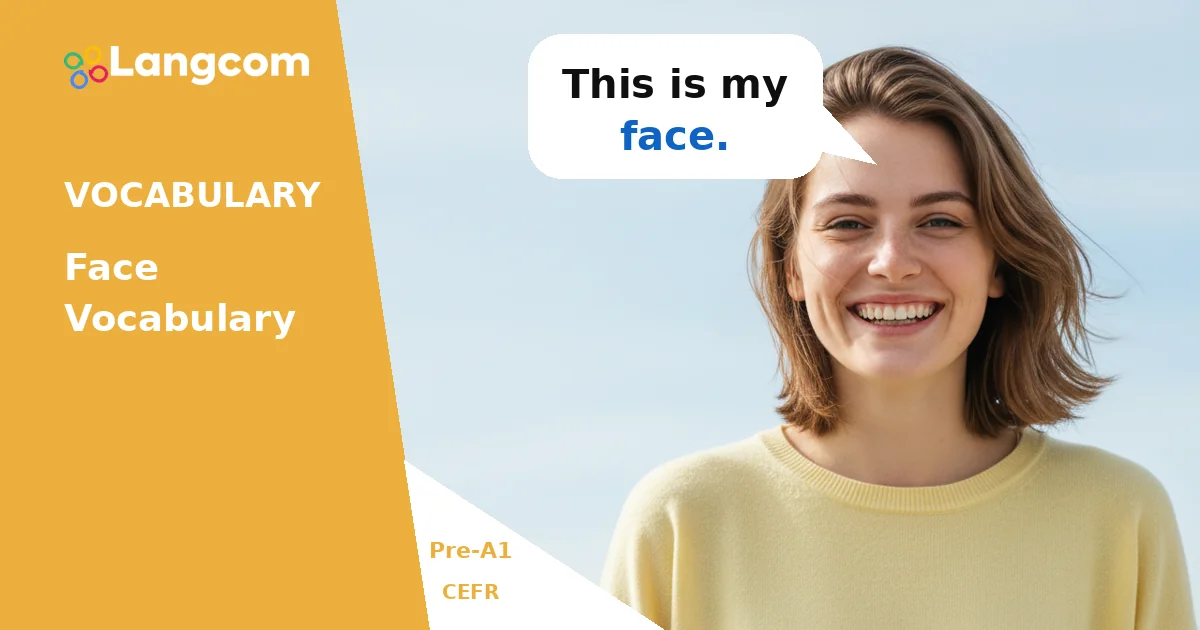

Learning the words for parts of the face is a great first step in English! Your face is the front part of your head. It has many important parts that help you see, hear, smell, and speak. Knowing these words helps you describe yourself and others. You will learn common words like eyes, ears, nose, mouth, et teeth. These are basic words for everyday conversation. For example, you use your eyes to see the world. You use your ears to hear sounds. This lesson will help you understand and use these words easily. It is important to know these words to talk about people and their appearance. Let’s start to learn the names of these parts of your face!
What is your face?
Your face is the front part of your head. It has many different parts.
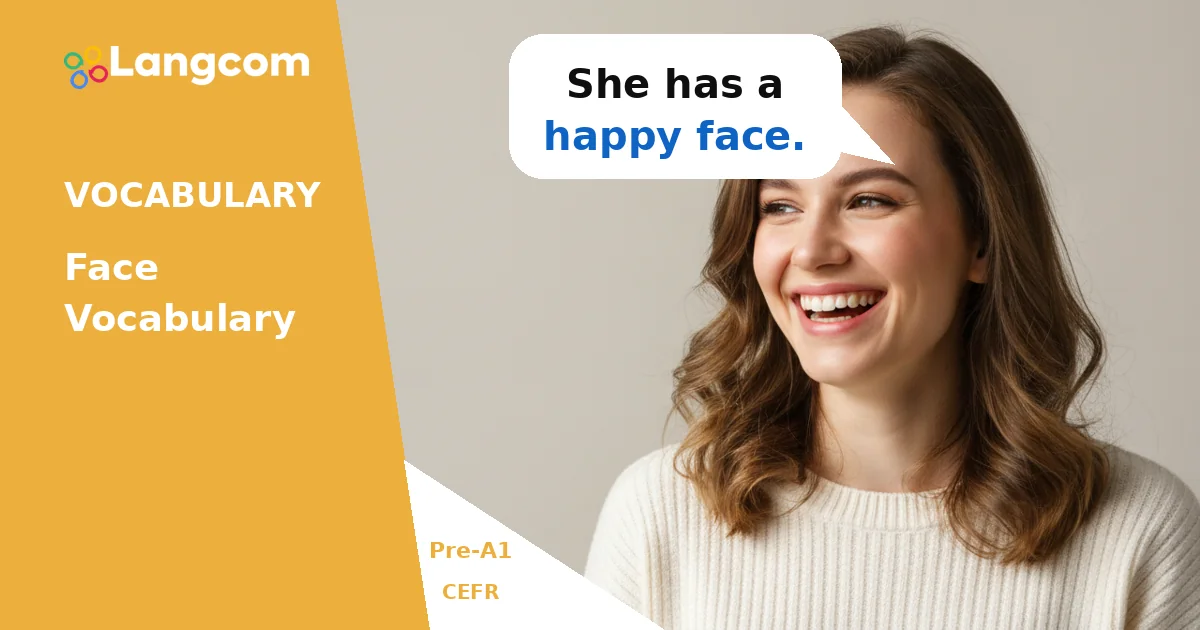
- We use our face to show feelings like happy or sad.
🎓 Apprenez l'anglais grâce à la méthode mixte
Petits groupes · Tuteur IA disponible 24 h/24, 7 j/7 · Préparation aux examens de Cambridge
Plans provenant de $39 $79 par mois
What are your eyes for?
You have two eyes.
- You use your eyes to see.
- People have different eye colors, like blue, brown, or green.
What are your ears for?
You have two ears.
- You use your ears to hear sounds.
- You can hear music or people talking with your ears.
What is your nose for?
You have one nose.
- You use your nose to smell things.
- You can smell flowers or food with your nose.
What is your mouth for?
You have one mouth.
- You use your mouth to eat food and to speak.
- When you smile, you open your mouth.
What are your teeth for?
Inside your mouth, you have teeth.
- You use your teeth to chew food.
- You also use your teeth when you smile.
| Mot anglais | What it is for |
|---|---|
| face | The front part of your head. |
| eyes | To see. |
| ears | To hear. |
| nose | To smell. |
| mouth | To eat and speak. |
| teeth | To chew food. |
Exemples
- This is my face.
- I have brown eyes.
- She has small ears.
- My nose is small.
- Open your mouth.
- He has white teeth.
- I can see with my eyes.
- I can hear with my ears.
- I can smell with my nose.
- I can eat with my mouth.
Entraînement
💬 Vous avez besoin de conseils personnalisés ?
En tant que centre de préparation agréé par Cambridge, nous pouvons vous aider à choisir la formation et la certification qui vous conviennent. Discutez-en dès aujourd'hui avec nos conseillers.
Discutez avec un conseiller sur WhatsAppErreurs courantes chez les hispanophones
Spanish speakers sometimes make these common mistakes:
- Using singular instead of plural: In Spanish, you might say "el ojo" (the eye) for both eyes. In English, we usually talk about two eyes.
- Wrong: My eye are blue.
- Right: My eyes are blue.
- Missing the possessive adjective: In Spanish, you might say "la boca" (the mouth). In English, we often use "my" or "your" to show who the body part belongs to.
- Wrong: Open the mouth.
- Right: Open your mouth.
Questions fréquemment posées
How do you say "cara" in English?
In English, "cara" is face.
How many eyes do people usually have?
Most people have two eyes.
What do you do with your mouth?
You use your mouth to eat, drink, and speak.
Is "teeth" singular or plural?
Teeth is a plural word. The singular form is tooth.

0 commentaire