
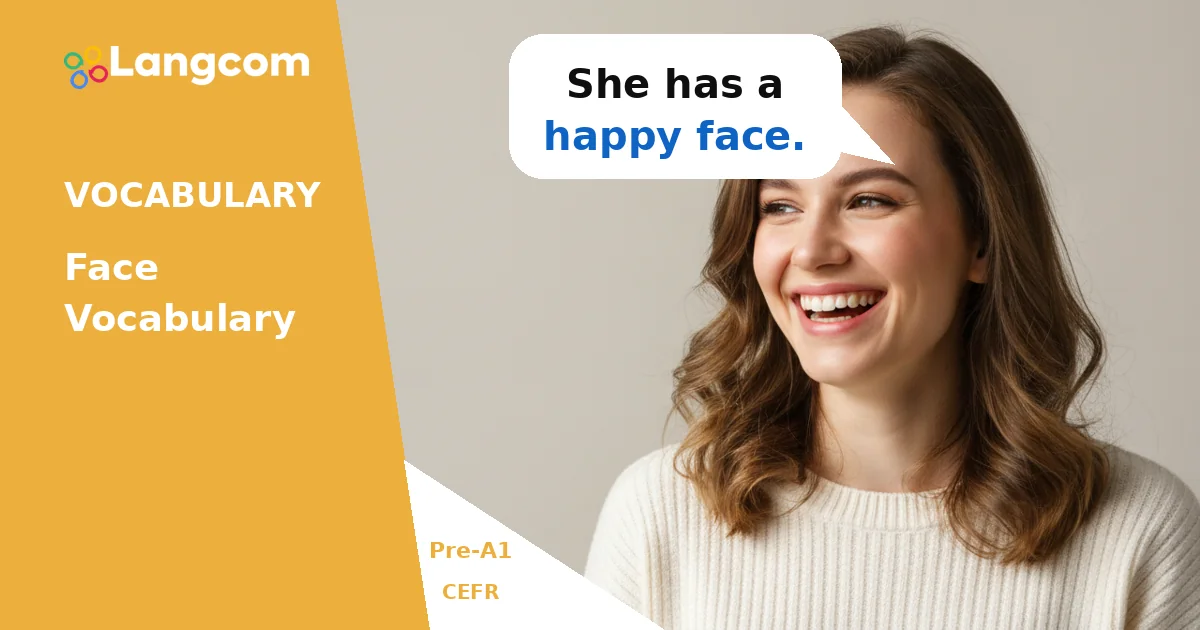

What is the face?
The face is the front part of your head. It is where you find many important parts of your body.
- It helps you show feelings like happy or sad.
- Many senses are on your face.
🎓 Learn English with the Blended method
Small groups · 24/7 AI Tutor · Cambridge preparation
Plans from $39 $79 per month
What are eyes?
You have two eyes on your face. They are for seeing.
- You open your eyes to see.
- You close your eyes to sleep.
What is the nose?
You have one nose in the middle of your face. It is for smelling.
- You can smell flowers with your nose.
- You also breathe with your nose.
What is the mouth?
You have one mouth below your nose. It is for eating and speaking.
- You open your mouth to eat food.
- You use your mouth to talk to people.
What are ears?
You have two ears on the sides of your head. They are for hearing.
- You hear music with your ears.
- You hear people talking with your ears.
What are teeth?
Inside your mouth, you have many teeth. They are for chewing food.
- Teeth help you eat apples and bread.
- You brush your teeth to keep them clean.
| English Word | What it is for |
|---|---|
| face | The front part of your head |
| eyes | For seeing |
| nose | For smelling and breathing |
| mouth | For eating and speaking |
| ears | For hearing |
| teeth | For chewing food |
Examples
- She has a happy face.
- I see with my eyes.
- My nose is small.
- Open your mouth, please.
- I hear with my ears.
- He has white teeth.
Practice
💬 Need personalized guidance?
As an Authorized Cambridge Preparation Centre, we can guide you to the right course and certification. Chat with our advisors today.
Chat with an Advisor on WhatsAppCommon mistakes for Spanish speakers
A common mistake for Spanish speakers is confusing the singular and plural forms of tooth. In English, we say one tooth (singular) but many teeth (plural).
- Correct: I have many teeth.
- Incorrect: I have many tooths.
Remember that teeth is already plural.
Frequently asked questions
Why is it important to learn these words?
Learning words like face, eyes, and mouth helps you describe people and understand basic conversations. They are very common in everyday English.
How can I remember these new words?
You can point to your own face, eyes, nose, mouth, ears, and teeth as you say the words. Practice saying them aloud and use them in simple sentences.
Are there other words for parts of the face?
Yes, there are many more words for parts of the face, like hair or chin. But face, eyes, nose, mouth, ears, and teeth are excellent words to start with at Pre-A1 level.


0 Comments