
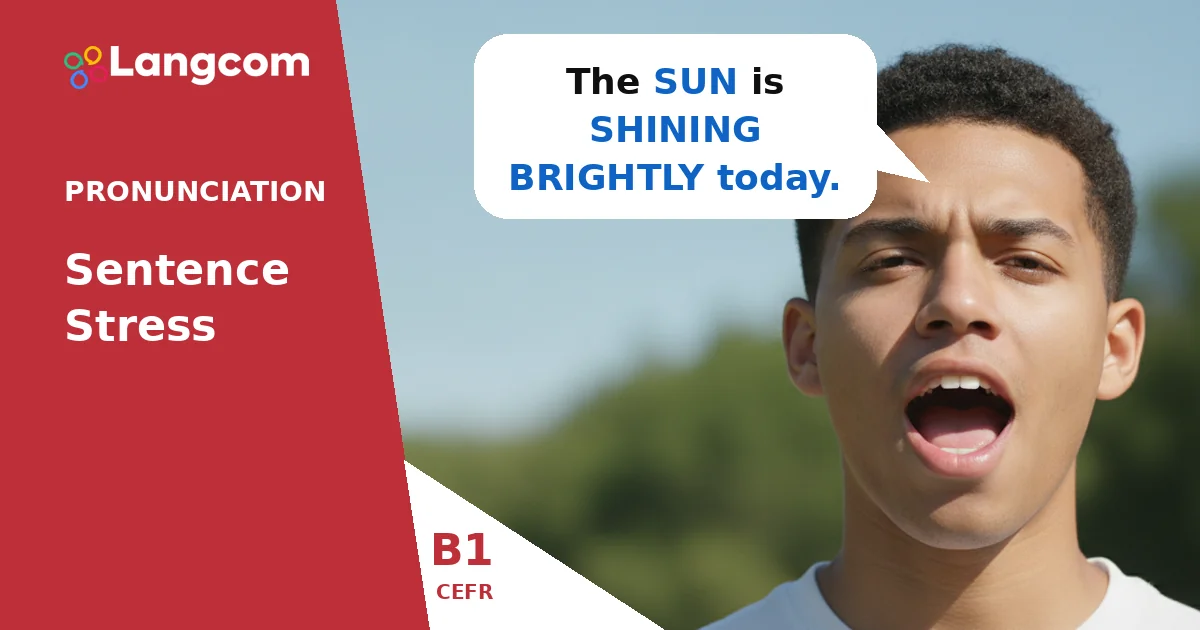

What is Sentence Stress in English?
Sentence stress refers to the emphasis we place on certain words within a sentence. When we stress a word, we say it louder, longer, and often with a higher pitch.
This is different from word stress, which is about which syllable is stressed within a single word (e.g., PHO-to-graph vs. pho-TOG-ra-pher). Sentence stress applies to the whole sentence.
- English is a stress-timed language. This means that stressed syllables happen at roughly equal intervals, and unstressed syllables are shortened to fit.
- Other languages, like Spanish, are syllable-timed, where each syllable takes a similar amount of time.
[langcom_cta variant=”blended”]
Why is Sentence Stress Important for B1 Learners?
Understanding and using sentence stress correctly is crucial for several reasons:
- Clarity: It helps your listener understand which information is most important in your sentence.
- Natural Sound: Your English will sound much more natural and fluent, like a native speaker.
- Listening Comprehension: When you understand how native speakers use stress, it becomes easier to understand them.
- Avoiding Misunderstandings: Sometimes, changing the stress can change the meaning of a sentence.
Which Words Do We Usually Stress? (Content Words)
In English, we typically stress ‘content words’ because they carry the main meaning of the sentence. These words give you the key information.
- Nouns: Words for people, places, things, or ideas. The DOG is BARKING.
- Main Verbs: Action words. She RUNS very FAST.
- Adjectives: Words that describe nouns. It was a BEAUTIFUL DAY.
- Adverbs: Words that describe verbs, adjectives, or other adverbs. He spoke QUICKLY.
- Question Words: Who, what, where, when, why, how. WHERE are you GOING?
- Demonstratives: This, that, these, those. I like THIS one.
Which Words Do We NOT Stress? (Function Words)
‘Function words’ are usually unstressed. These words are important for grammar but don’t carry the main meaning. They are often pronounced quickly and sometimes reduced (e.g., to sounds like ‘tuh’).
- Articles: a, an, the. I want A BOOK.
- Prepositions: in, on, at, for, to. She went TO the STORE.
- Conjunctions: and, but, or. Coffee AND TEA.
- Auxiliary Verbs: be (is, am, are), have (has, had), do (does, did), will, can, should. He IS READING. (Note: Auxiliary verbs can be stressed for emphasis or in short answers.)
- Pronouns: I, you, he, she, it, we, they. HE saw HER.
- Possessive Adjectives: my, your, his, her, its, our, their. Is THAT YOUR BAG?
How Can Stress Change the Meaning?
Sometimes, we can stress a word that is usually unstressed to add emphasis or change the specific meaning of a sentence. This is called ‘contrastive stress’.
- Consider the sentence: I didn’t say she stole my money.
- If you stress I: I didn’t say she stole my money. (Someone else said it, not me.)
- If you stress say: I didn’t SAY she stole my money. (I implied it, or wrote it, but I didn’t say it.)
- If you stress she: I didn’t say SHE stole my money. (Someone else stole it, not her.)
- If you stress stole: I didn’t say she STOLE my money. (She just borrowed it, or took it by mistake.)
- If you stress my: I didn’t say she stole MY money. (She stole someone else’s money.)
- If you stress money: I didn’t say she stole my MONEY. (She stole something else, like my car.)
| Stressed (Content Words) | Unstressed (Function Words) |
|---|---|
| Nouns (e.g., house, idea) | Articles (e.g., a, the) |
| Main Verbs (e.g., run, eat) | Prepositions (e.g., in, on) |
| Adjectives (e.g., big, happy) | Conjunctions (e.g., and, but) |
| Adverbs (e.g., quickly, very) | Auxiliary Verbs (e.g., is, have) |
| Question Words (e.g., what, where) | Pronouns (e.g., he, them) |
Examples
- The SUN is SHINING BRIGHTLY today.
- WE went TO the CINEMA LAST night.
- SHE wants TO BUY a NEW DRESS.
- WHAT did YOU DO on SATURDAY?
- HE’S a VERY GOOD TEACHER.
Practice
[langcom_cta variant=”placement”]
Common mistakes for Spanish speakers
A common mistake for Spanish speakers is to give equal stress to almost all words in a sentence. Because Spanish is a syllable-timed language, every syllable tends to have similar length and strength.
In English, this can make your speech sound flat or unnatural, and sometimes difficult for native speakers to understand. Remember to identify the content words and give them more emphasis, while reducing the function words.
- Incorrect (too much stress): I AM GOING TO THE STORE.
- Correct (natural stress): I’m going to the STORE. (The unstressed words are reduced and said quickly.)
Frequently asked questions
What is the main difference between English and Spanish rhythm?
English is a stress-timed language, meaning some syllables are longer and stronger. Spanish is a syllable-timed language, where syllables have more equal length.
Does sentence stress affect meaning?
Yes, changing the stressed word can change the focus or meaning of a sentence. For example, I bought a car (I, not someone else) versus I bought a CAR (not a bike).
How can I practice sentence stress?
Listen carefully to native speakers, especially in movies, podcasts, or songs. Try to imitate their rhythm. Read sentences aloud, identifying content words to stress and function words to reduce. You can also record yourself and compare it to a native speaker.




0 Comments